
Independent assessments and validations of corporate low-carbon transition strategies offer valuable insights for investors, policymakers and other stakeholders. However, there is limited understanding of how individual methodologies cover key policy-relevant transition components underlying their assessment outputs and methodological differences. In this article, published in the Climate Policy Journal, we assess the methodological design choices of ten corporate low-carbon transition strategy assessments with publicly available methodologies and results.
Key policy insights
- Independent initiatives use a variety of methods to assess companies and produce important data for the governance of corporate low-carbon transition strategies.
- Regulators should adopt measures that strengthen the scale and quality of data on corporate climate strategies, leveraging methodological advancements developed by independent assessment initiatives.
- Establishing a centralised repository to track and provide public access to assessment methodologies would support their integration into regulatory frameworks.
- In the interim, composite assessments that integrate multiple data sources can enhance collaboration within the governance ecosystem and help fill assessment coverage gaps while preserving the strengths of individual methodologies.
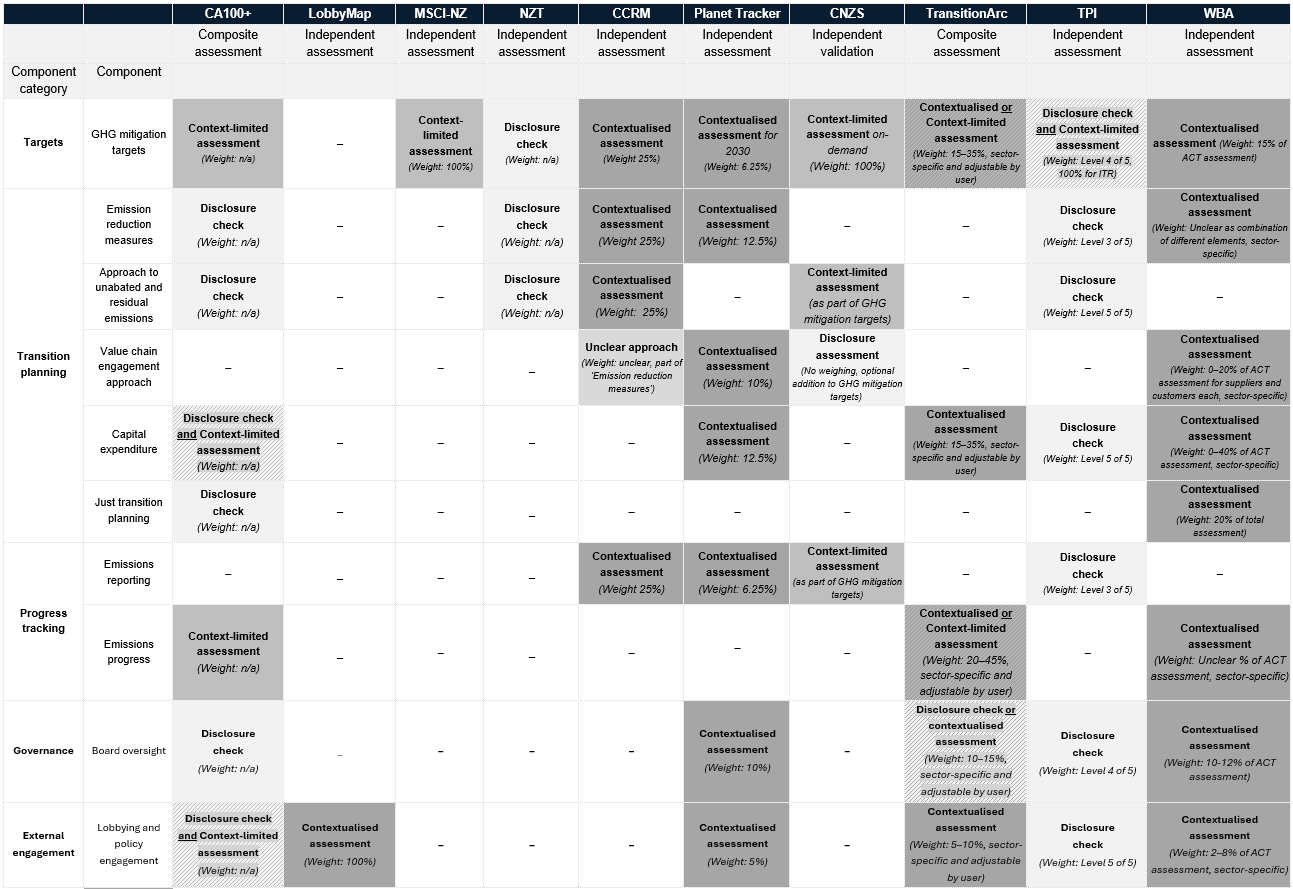
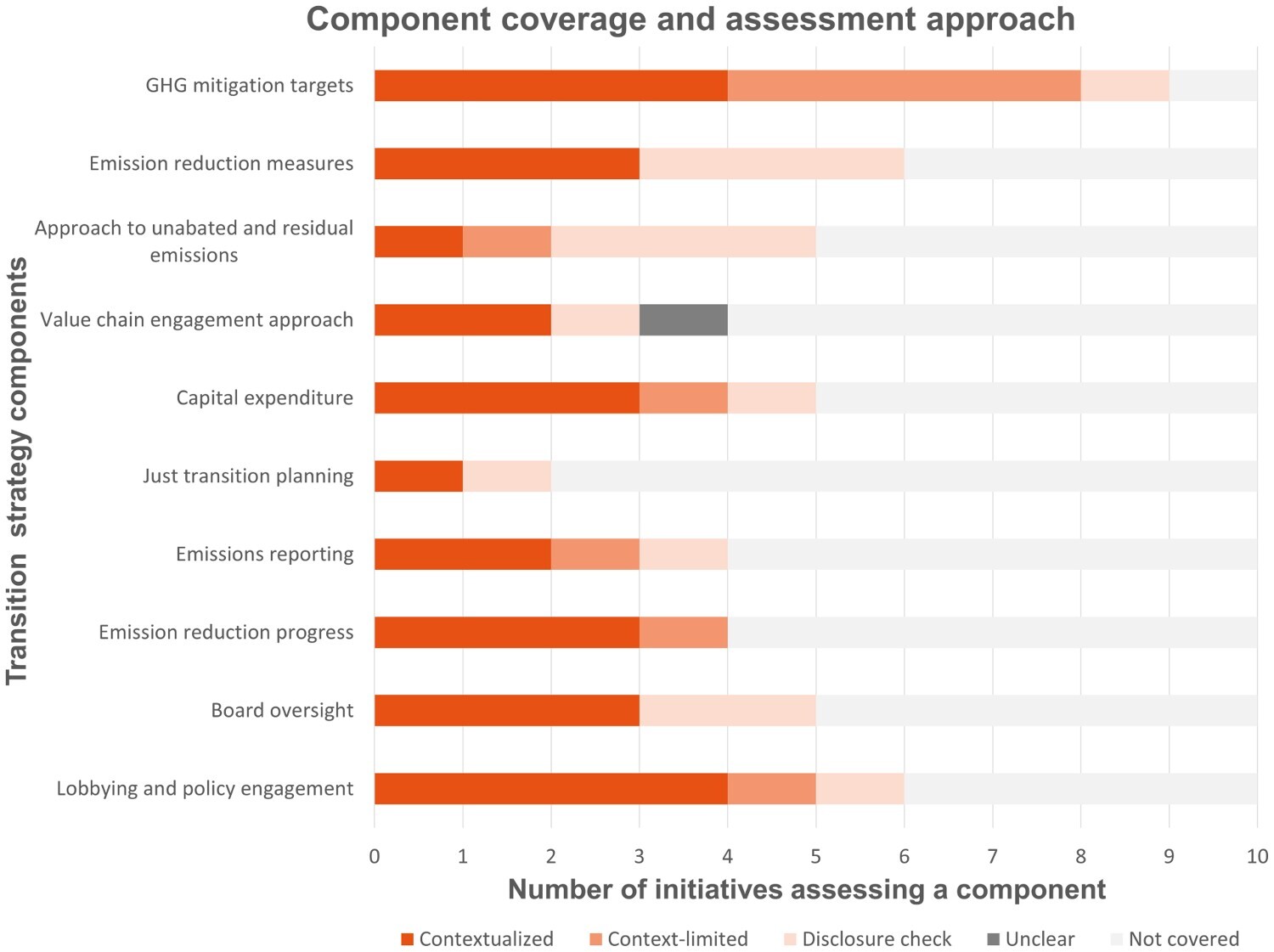
We develop a two-part framework to compare the assessment setup and the coverage of key transition strategy components. We illustrate the differences, using the assessment outcomes for a major global company. Our findings help policymakers navigate the heterogeneity in key methodological parameters, notably in component coverage, the assessment approach per strategy component and weighting. We show that no single assessment initiative provides fully up-to-date, contextualised evaluations of all transition strategy components for more than 1000 companies, which is a key limitation. However, composite assessments, which integrate multiple assessments as sources, are emerging to address gaps in criteria coverage while maintaining contextualised assessments for each criterion. We propose a centralised repository to track and compare assessment methodologies, supporting an understanding of methodological variances and synergies between initiatives. Finally, this article provides the foundation for further research on sector-specific methodological differences and on aligning assessment methodologies with emerging global standards. Read the full article here.
The work was funded through the ACHIEVE project, which has received funding from the European Union’s HORIZON EUROPE Research and Innovation Programme under grant agreement No 101137625.